Term Used in Art to Make a Photos Colors Stand Out
Designers have a vocabulary all their own. If yous're getting design piece of work done, knowing the right terminology will assistance you communicate with ane another and go the results you lot envision. (We promise it's a whole lot easier than loftier school French.)
Take a look at these design terms. Study them. Commit them to memory. Eh… That's too much work. But bookmark this page and employ it equally your design word cheat sail. Here are the near important descriptive pattern words you should know:
- Pattern: composition, balance, proximity, alignment, repetition, contrast, white space, hierarchy
- Photography & artwork: resolution, DPI, PPI, bleed, trim, pixels, crop, stock photo
- Typography: serif, sans serif, script, ascender, baseline, descender, kerning, leading, tracking, weight
- Colour: hue, tint, tone, shade, saturation, monochromatic, analogous, complementary, triadic, opacity, CMYK, RGB
- Website elements: header, navigation bar, breadcrumb trail, landing folio, HTML, user interface, wireframe
- File formats: AI, EPS, PDF, GIF, JPEG, PNG, PSD, TIFF
- Logo types: abstract mark, emblem, lettermark, pictorial marker, mascot, wordmark
Design
—
Composition and layout
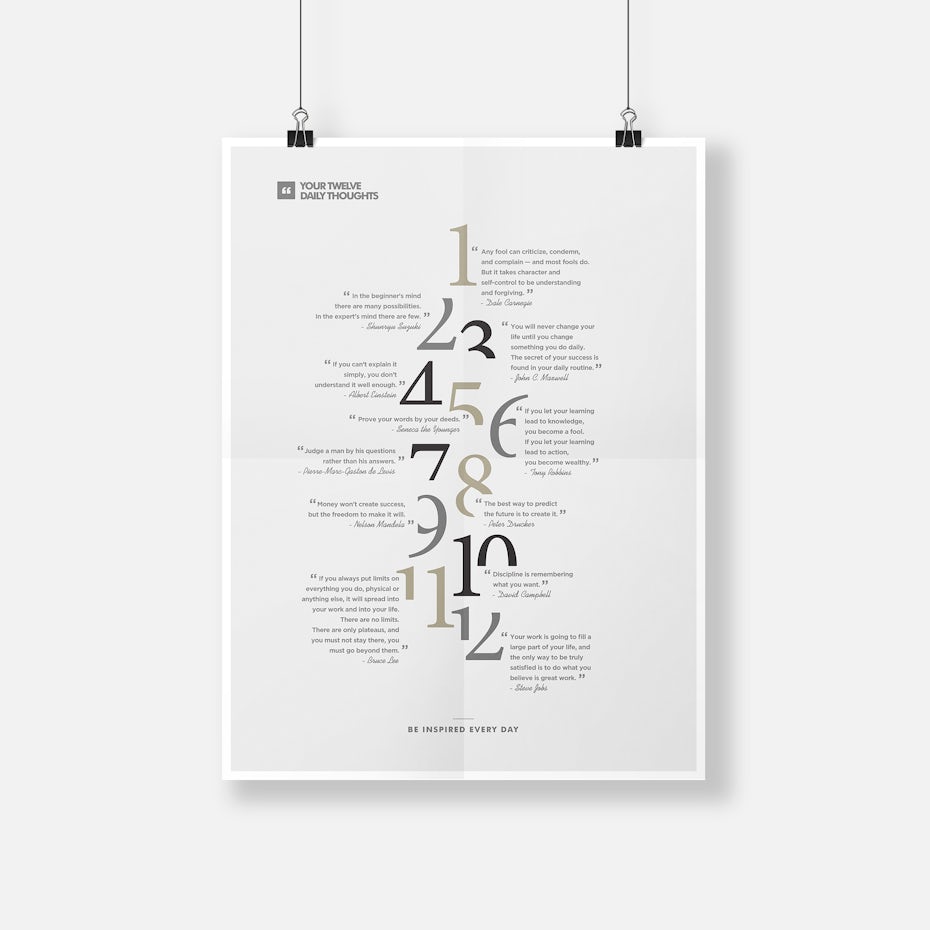
Limerick is the arrangement of design elements that form a whole paradigm. A successful composition attracts the viewer and guides their heart across the design. In visual art, y'all might hear this referred to as "form." In graphic blueprint, information technology's oft called layout. Limerick is made up of a number of different visual pattern elements, including residual, proximity, alignment, repetition, dissimilarity and white infinite.
Residual
This isn't your ability to walk a directly line after three beers. In blueprint, residual involves the placement of elements on the page and so that the text and graphic elements are evenly distributed. There are 3 ways to achieve balance: symmetrically, asymmetrically and radially.

Symmetrical
Symmetry is achieved when all design elements are equal on both sides of a cardinal line
Asymmetrical
When graphics and text are not equal on both sides of a central line, a design is said to exist asymmetrical. In the example to a higher place, there is however balance, but in that location are graphics on one side and text on the other
Radial
A radial design is one in which elements radiate from a central point, creating balance.
Proximity
The way in which pattern elements are grouped or spaced on a page is chosen proximity. Great blueprint groups like elements together.
Alignment
Alignment is the position of text or graphics, whether left, right, centered or full justified..
Repetition
To maintain a unified await, designers repeat elements throughout a design. (Repetition is as well divers every bit the number of times your toddler asks for a cookie.)
Contrast
Contrast is accomplished by including elements within the design that look measurably different from one another. A designer may use color, shape, texture, size or typeface to create contrast.
White space
White space—sometimes called negative space—is the part of the design that is unmarked by imagery or text. It's also what Midwesterners call their depressing, winter mural.

Rule of thirds
The dominion of thirds is a technique that designers apply to make up one's mind focal indicate. Using a grid of three rows and columns, focal points are indicated where the lines converge. Designers utilise this as a guide to determine where to place of import elements in their pattern.
Grid
A grid is a series of intersecting vertical, horizontal, angular or curved lines used to organize graphic elements on a folio, as well every bit in relation to one some other.
Bureaucracy
In design, hierarchy is the arrangement of elements by level of importance. Newspapers, magazine spreads and motion picture posters are good examples of the use of design hierarchy. Headlines (likewise called display type) are usually placed at the acme, while subheads and body copy fall underneath.

Scale
Calibration is the size of an object in relation to another object (not that thing in your bathroom that yous curse at each morning). Scale tin exist used to create involvement and catch a viewer's attending.
Thumbnail sketch
When conceptualizing, a designer will often create small, rough drawings—thumbnail sketches—to explore many ideas.
Mock-up
A mock-upwards is a real or digital model used to exam early design ideas and see how they could look in the real world.
Photography & Artwork
—
Resolution
The item of an epitome based on the number of pixels is known as resolution. An prototype looks clearer when it has a higher resolution.
DPI
DPI stands for "dots per inch," which is a measure of a printer's quality. For high-quality printing, 300dpi is recommended. For case, a 300dpi paradigm at 1200×1800 pixels will become every bit a iv×half dozen inch print.
PPI
PPI stands for "pixels per inch," which is a measure of pixel density used by electronic image devices. You'll likely meet this used with scanners, cameras, TVs or monitors. Larn more about the difference betwixt DPI and PPI .
Bleed
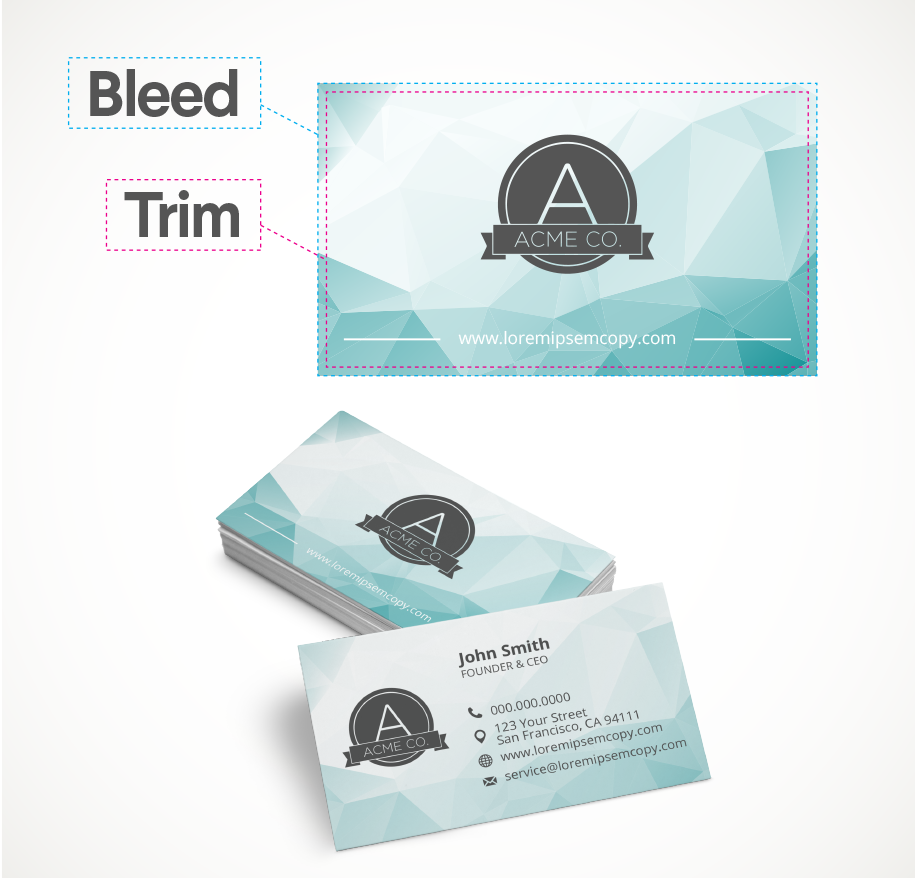
Sounds pretty gruesome, just bleed is when a pattern actually extends past its printed edge and so there's no chance of white borders when it'due south trimmed down afterward printing.
Trim
Trim size is the concluding size of a printed slice after it has been trimmed from its page. Trimming is executed along crop marks that prove where to cut.
Pixels
Pixels are square-shaped dots that make a digital raster paradigm (and a really bad motion picture starring Adam Sandler.) The more pixels an image has, the higher its resolution.
Ingather
A designer tin can cut out or crop unnecessary parts of an prototype to improve framing, highlight a specific subject or alter the image'due south attribute ratio.
Stock photo/art
Stock photos and art are licensed images created by a third party. Using stock images saves on the cost of a having a professional person photo shoot. Check out some of our favorite places to become good, gratuitous stock imagery .
Typography
—
Font types
Most fonts autumn into one of iv unlike font types.
Serif
Serifs are the small lines and hooks at the terminate of the strokes in some letters.
Sans serif
Sans ways "without." A sans serif font has no serifs.
Script
Script typefaces utilise a flowing, cursive stroke.
Slab serif
Slab serif is distinguished past thick, block-similar serifs.
Components of type
All fonts are fabricated of the aforementioned basic components.
Ascender
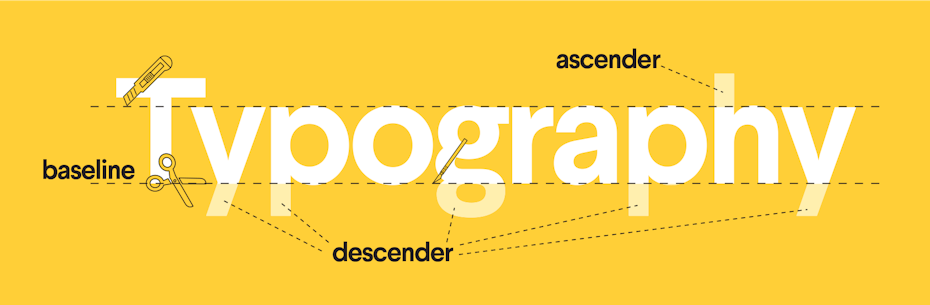
An ascender is the function of a lowercase letter that rises in a higher place the chief body of the alphabetic character. Think "b" or "h."
Baseline
All font characters sit down on the baseline, the lowest bespeak of all upper-case letter messages and most lowercase letters.
Descender
A descender is the role of a lowercase alphabetic character that descends beneath the principal body of the letter of the alphabet. Think "one thousand" or "p."
Median/x-top
The median or x-acme is where most lower-case messages should accomplish their maximum height. It is set from the height of the ten in a font.
Font spacing
The vertical and horizontal spacing of a font is often altered to change its appearance.
Kerning
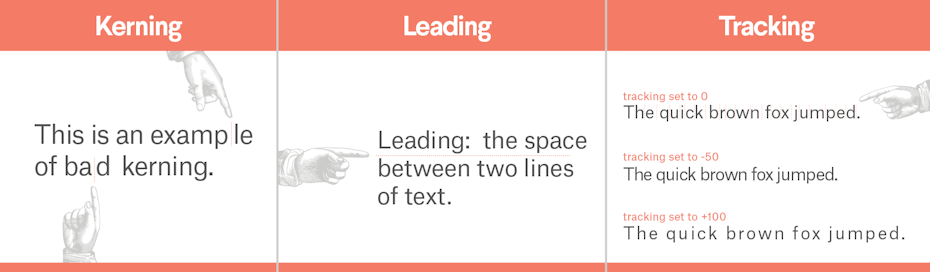
Kerning is the adjustment of space between pairs of letters in the same word. Certain pairs of letters create bad-mannered spaces, and kerning adds or subtracts space between them to create more visually highly-seasoned and readable text.
Leading
Pronounced "ledding," leading (also known equally line-elevation) is the space between two lines of text.
Tracking
Non to be confused with kerning, tracking is the adjustment of space for groups of letters and entire blocks of text. Tracking affects every grapheme in the selected text and is used to change its overall appearance.
Font instance
Typically, characters are available in ii forms.
Uppercase
The large, majuscule letters of a typeface are majuscule. They're besides used by your mom to accidentally YELL AT YOU WHEN SHE TEXTS YOU.
Lowercase
Lowercase refers to the small messages of a typeface.
Small caps
Small caps—or small capitals—are majuscule characters that are the same tiptop every bit lowercase letters. They are used to prevent capitalized words from appearing besides big on the page. Want an example? Open just most any book and look at the opening words of a chapter.
Font manner
Across spacing and instance, fonts can also exist altered past scale, weight and style.
Point size
Point size is the size of text. There are approximately 72 (72.272) points in one inch.
Font weight
Font weight specifies the boldness of a font.
Italics
When characters gradient to the right , they're in italics, a visual technique used to draw attention to specific words or sentences within a paragraph.
Widows & orphans
Widows and orphans brand designers very sad. That's because they are poor, alone words at the offset or end of a paragraph left dangling at the elevation or bottom of a column and separated from the rest of the paragraph.
Lorem ipsum
Lorem ipsum (also known as dummy text) is used every bit a placeholder that will be swapped out afterwards with actual copy. The Lorem ipsum text comes from "The Extremes of Good and Evil," written past Cicero in 45 BCE.
Color
—
Color theory
The written report of how colors make people feel and their effects on a design is known as color theory. Color theory is used to explore the best types of colors to work in different design instances—for example, choosing a pastel scheme for a website that needs to feel soft, or picking cerise and yellow for a magazine ad that needs to evoke energy.
Hue, tint, tone and shade
Hue is pure colour. Tint is a hue with white added. Tone is a hue with grayness added. Shade is a hue with blackness added.
Saturation
Saturation is defined by the intensity of color.
Palette
A palette is the range of colors used in a design. These are colors that work well together and are oft aesthetically pleasing. Designers volition defines a palette for a projection to create consistency and evoke a specific feeling.
Warm and absurd colors
Warm colors can be found on one half of the color cycle (reds, oranges, yellows and pinks). Cool colors occupy the other half (blues, greens and purples).
Monochromatic
A monochromatic color palette uses one unmarried color.
Grayscale
A monochromatic color palette based on grey is called grayscale.
Analogous
Colors that are next to one some other on the color wheel (i.due east. scarlet violet, red and blood-red orangish) are coordinating.
Complementary
Complementary colors are opposites on the color wheel. This relationship will produce visual tension and "stupor."
Triadic
Triadic colors are 3 colors evenly spaced on the color wheel. One colors dominates, the 2nd supports, and the third accents.
Gradient
Gradient is a gradual modify from 1 colour to another. (For example, blue transitioning gradually to green).
Opacity
Opacity is synonymous with non-transparency. The more than transparent an image, the lower its opacity.
CMYK
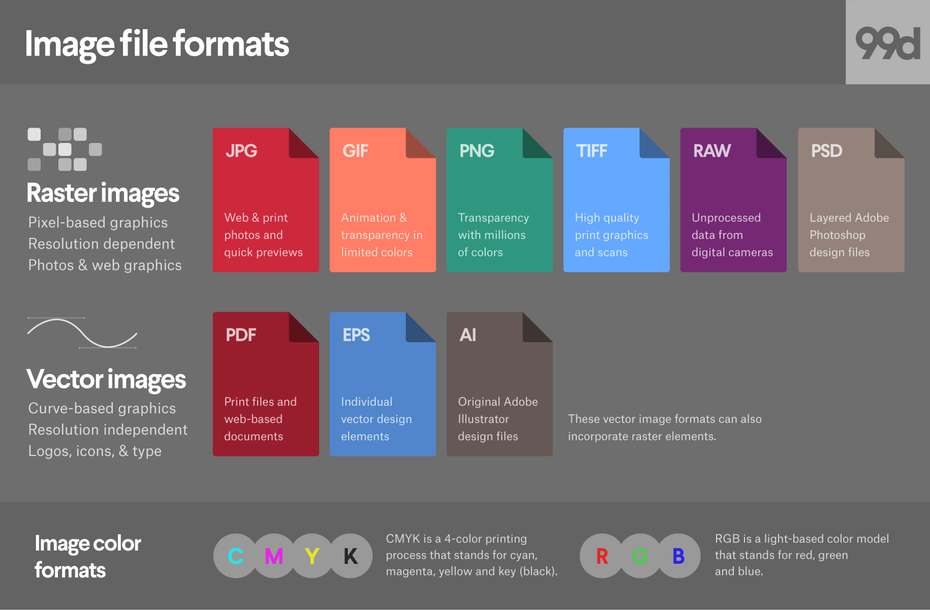
CMYK is a 4-color printing procedure made up of cyan, magenta, yellow and central (black). CMYK colors in impress will never appear as vibrant every bit RGB colors on screen because CMYK creates color by adding color together (making images darker) while RGB colors come from calorie-free.
RGB
RGB stands for red, light-green and bluish, the three colors of calorie-free typically used to display images on a digital screen.
Pantone
Developed by Pantone Corporation , a professional colour company, Pantone is the most widely used, proprietary color system for blending colors. The organisation includes colors that cannot exist mixed in CMYK.
Web & digital
—
Web page elements
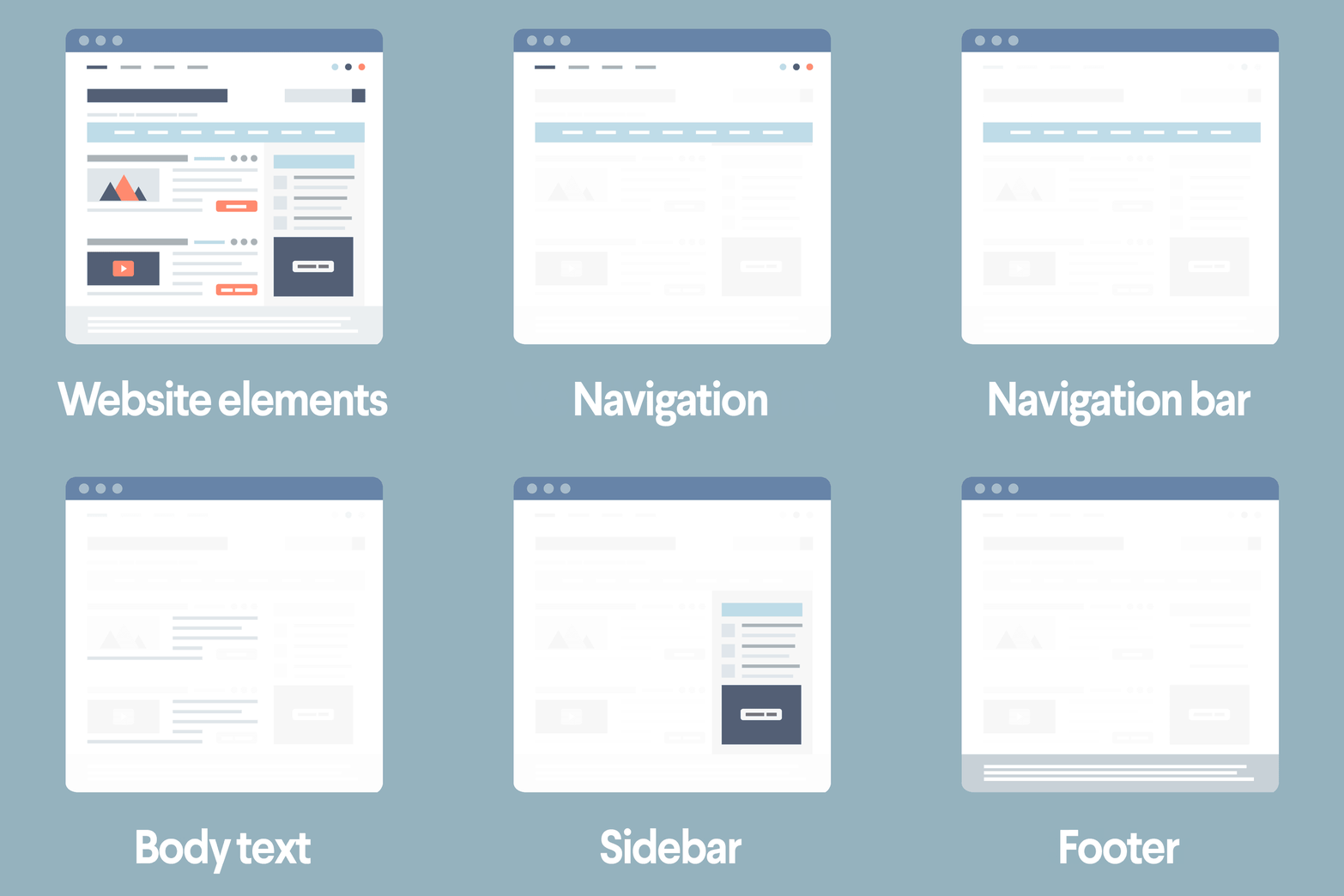
Most web page designs include combination of these elements.
Header
Design elements repeated at the top of every page is called a header.
Navigation & navigation bar
Navigation is a roadmap to the most of import parts of a website and should be visually consistent beyond all pages. A navigation bar is a set of links repeated on each page that oftentimes includes links to pages like "About us", "Products," "Contact us" and "Testimonials."
Breadcrumb trail
Breadcrumbs are navigation elements that mostly announced about the top of a folio to show users the section hierarchy of the current page.
Body text
Body text is the chief written content of a page.
Links
Any discussion or an image can be a link that can take users to another page.
Sidebar
A sidebar is the left or righthand column of a page typically used for either vertical navigation links or advertising. It may besides contain site search, subscription links (RSS, newsletters, etc.) or social network buttons.
Banner
Typically located at the top of a page or in a sidebar, banners are advertisements that link to other websites.
Footer
Blueprint elements repeated at the bottom of every folio is chosen a footer.
HTML
HTML stands for HyperText Markup Language. This is the standard coding linguistic communication for websites that creates all of the fonts, colors, graphics and links you encounter online.
Landing folio
A landing page is a single page that appears in response to search engine issue. Landing pages are used for lead generation.
User interface (UI)
User interface is the design of applications for computers, mobile devices and other devices to maximize their usability and the user experience.
Wireframe
Basic images that brandish the essential functions of a website are known as wireframes. Designers use wireframes to evidence how a page or site works.
Prototype file formats
—
An paradigm file format is a standardized way to encode fine art, graphics and photos digitally.
Vector graphics
Vector graphics are small graphics that use math to brandish images. They can be enlarged without losing quality and are essential for cross-platform designs (i.due east. billboards, business cards, etc.).
AI
AI stands for Adobe Illustrator document. This is a file format adult by Adobe Systems to represent single-folio vector designs.
EPS
EPS stands for Encapsulated Post Script. This is a resizable file format that is commonly used for vector designs. Due to its loftier quality, it'southward commonly used with print elements such equally logos, business organization cards or brochures.
A PDF is a Portable Document Format adult past Adobe that tin exist universally downloaded and viewed past any reckoner. PDFs are virtually suitable for sharing previews of piece of work and are universally viewable.
Raster graphics
Raster graphics are composed of pixels on a grid, where each pixel is assigned a colour value. They are good for assigning special furnishings, colour correction and manipulating photos. They are resolution-dependent, which means that images cannot be enlarged without degrading their quality.
GIF
GIF or Graphics Interchange Format is a raster file format that supports blitheness and transparency. GIFs can merely display up to 256 colors, allowing for very small file sizes. (PS: Information technology's pronounced, "JIF" as opposed to the widely-accustomed pronunciation, "GIF," according to GIF creator, Steve Wilhite.)
JPEG
Articulation Photographic Experts Group is besides known as JPEG, the most widely used raster file type for web-based designs. JPEGs are compressed files that load chop-chop. You'll typically encounter them used for emails, banner ads, online photos, and pretty much anything else online. Dissimilar GIFs, they cannot have a transparent groundwork (a white background will exist added automatically).
PNG
PNG stands for Portable Network Graphics, a spider web-based format that does not lose quality when compressed. PNG files were created to improve on the quality of GIF files.
PSD
PSD or Photoshop Document is the uncompressed working raster image file created by designers in Adobe Photoshop.
TIFF
TIFF stands for Tagged Epitome File Format, a common format for exchanging raster images betwixt applications. TIFF produces a higher quality image than a JPEG or PNG, and is widely used among publishing industries and photographers. Don't confuse it with a "tiff" or a "rift," which happens when you lot send your designer eight rounds of revisions.
Logo types
—
All logos are built out of typography, shapes and/or images, and typically fit into one of these standard logo types . Each will give your brand or concern a different feel. These six types can too be combined with i another to create fifty-fifty more unique logos.
Abstract marking
An abstract mark is a logo that uses the emotive qualities of color and form to convey your make. Instead of being a recognizable epitome like an apple tree or a craven, abstract marks employ shapes to represent your business organisation.
Keepsake
Keepsake logos uses frames and shapes to enclose the company or organisation name. Call up badges, seals and crests.
Lettermark
Lettermark logos feature one or more stylized letters (for example, a company's initials) to place the brand. Famous lettermark logos include those for IBM, CNN, HP and HBO.

Pictorial marking or symbol
Pictorial marks and symbols are not-abstract, visual icons that represent your company name or service. You tin can see this with the Apple tree logo, the Twitter bird and the Target bullseye.
Mascot
Mascot logos rely on a grapheme or brand spokesperson to represent a business. Famous mascots include Colonel Sanders, the Kool-Assist Human being and Mr. Peanut.
Wordmark
A wordmark relies on custom typographic treatment of text to illustrate a brand. Remember VISA, Google or Coca-Cola.
Need some graphic design work done?
Our designers can create just well-nigh anything!
—
This article was originally written past Alex Bigman and published in 2014. The current version has been updated with new information and examples.
Source: https://99designs.com/blog/tips/15-descriptive-design-words-you-should-know/

Post a Comment for "Term Used in Art to Make a Photos Colors Stand Out"