Does the Baby Hear What I Hear With Headphones
Hither's a quick guide on how to know if your headphones are besides loud. Plus, some tips to go along your hearing safety.
While loud music can be exciting, you lot should know that the growing rates of hearing loss are attributed to loud noise and dangerous listening practices; a.k.a. headphone volume abuse.
As Carreen P. Henson, a Clinical Audiologist working in a hearing aid center, mentioned on the trend of hearing loss during the Covid-xix pandemic:
"Ever since the offset of the pandemic, since many people have shifted to the work from abode set up and online classes, I've had many patients come in for hearing consultations because of a decrease in hearing acuity."
If you're fond of listening to loud volumes, worry not! This guide will walk yous through how to tell if your headphones are too loud and everything yous need to know to prevent hearing loss. Allow's jump in.
What Makes Listening to Loud Headphones Bad?
Listening to your headphones at loud volumes for long periods could result in different hearing problems including:
- Tinnitus: A sensation of ringing, buzzing, or other noises in your ears.
- Imbalance: To help maintain balance, your brain receives impulses from your eyes, inner ear, muscles, and joints. Therefore, ear damage can upset this organisation and cause instances where you feel empty-headed or off-balance.
- Sensitivity. Your ear may develop sensitivity to everyday sounds and make them seem louder than usual.
- Hearing loss: Noise can damage the sound-receptive nerve fibers in the inner ear leading to permanent hearing loss.
"Noise-induced hearing loss oft causes sensorineural hearing loss which is really irreversible. In that location's no handling for sensorineural hearing loss, nonetheless, we exercise recommend hearing aids to assist slow downwardly the progression of hearing loss."
– Carreen P. Henson, Clinical Audiologist
How Loud is 'Likewise Loud' for Headphones?
The Globe Health Organization (WHO) suggests you should listen to your headphones at a volume level of 85 decibels (dB) for only 8 hours.
Yet, average audio devices have a sound level ranging from 75 to 136 dB. Typically, most listeners maintain the sound levels at effectually 75 dB to 105 dB when listening to audio. For this reason, you lot need to know how to rate the sound levels of your headphones so you can limit your listening time.
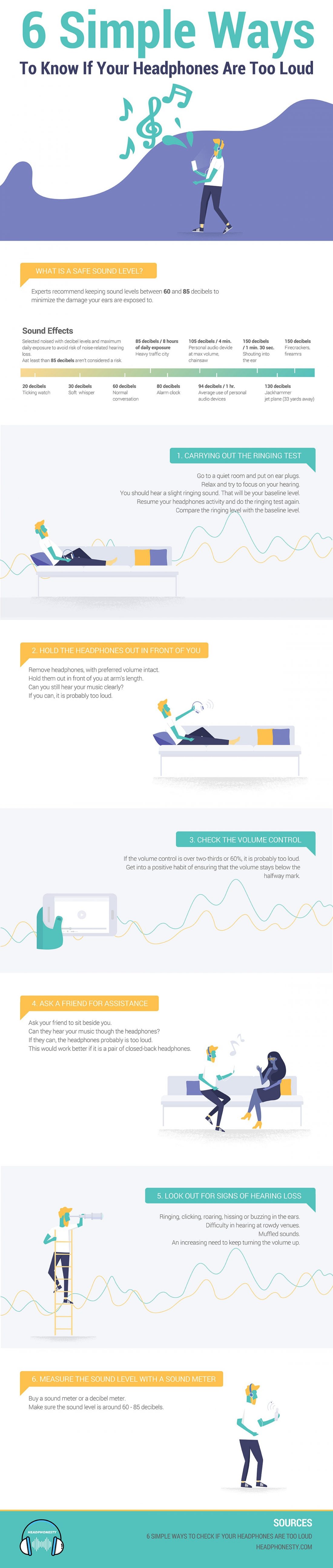
For that, let's accept a look at a decibel chart below:
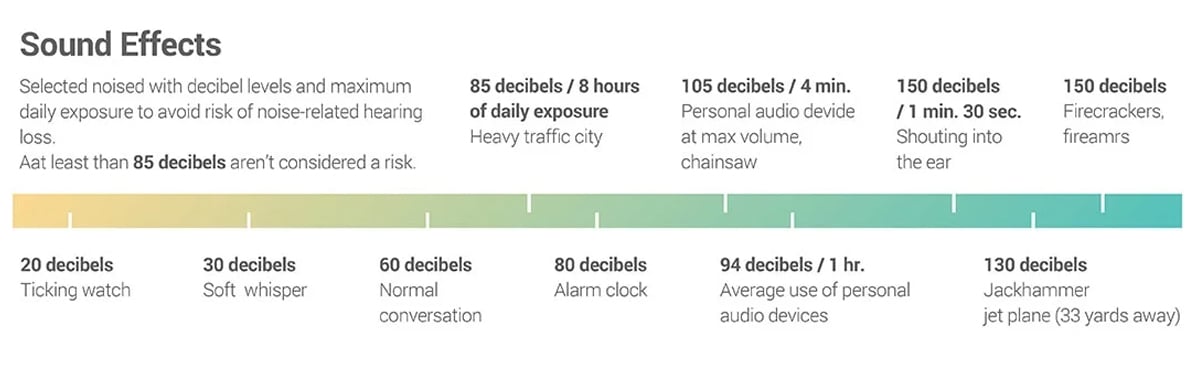
From the chart, we can see that annihilation below 85 dB isn't considered a risk to your hearing. This is why you can heed to audio that's rated at 85 dB for upwards to eight hours without risking racket-related hearing loss.
However, listening to more than 85dB is already marked cerise and can cause irreparable impairment. While you may not detect it, listening to headphones at 105dB and up for long periods is like listening to someone shouting into your ear for hours.
You can try to decide what each decibel-rated noise level sounds like by comparing it with other sounds in your environment. For example, an 85 dB noise level is akin to heavy urban center traffic, a busy hotel vestibule, or a garbage disposal system.
Withal, that isn't usually accurate and so y'all tin can still be at risk of the unlike hearing issues accustomed to loud headphone volumes. That'south why we've listed down some surefire means to bank check if your headphones are too loud in the next section. Read on.
vi Ways to Cheque if Your Headphones are Too Loud
- Behave out the ringing exam
- Hold your headphones out in front of you
- Check the volume control
- Ensure y'all don't struggle to hear people effectually yous
- Await out for signs of hearing loss
- Measure the sound level with a Sound Meter
1. Carry out the ringing examination
Ear ringing is a sensation in your ears that feels like whistling, hissing, buzzing, or even clicking. The people around y'all can't hear the ringing, and information technology tin can occur in one or both of your ears.
Ear ringing doesn't always hateful that you have tinnitus. At times, when you are in a tranquility environment, y'all may experience phantom ringing.
Not all ear ringing is audible 24/7. That's why this test will assist you determine if you're already experiencing ringing in the hears without fifty-fifty noticing.
This examination requires a simple pair of foam earplugs and a peaceful setting. To do this, accept a break from using your headphones and listening to any music for ii-three days.
After this menstruum, go to a quiet room and place the earplugs in your ears. Try to focus on your hearing. Relax equally much equally you can, concentrate on your breathing and remain completely nonetheless.
During the silence, you lot should hear a very slight ringing in your ears – this is your baseline level.
The next day, resume headphone activity equally normal. Then in the evening, redo the test in a serenity space. If the ringing is louder than it was in the earlier test, then the noise from your headphones is too powerful.
Repeat as regularly as you need to in order to gauge the issue of the volume level. When the ringing becomes more intense than your baseline level, it is fourth dimension to turn information technology down a notch or two.
2. Hold your headphones out in front of you
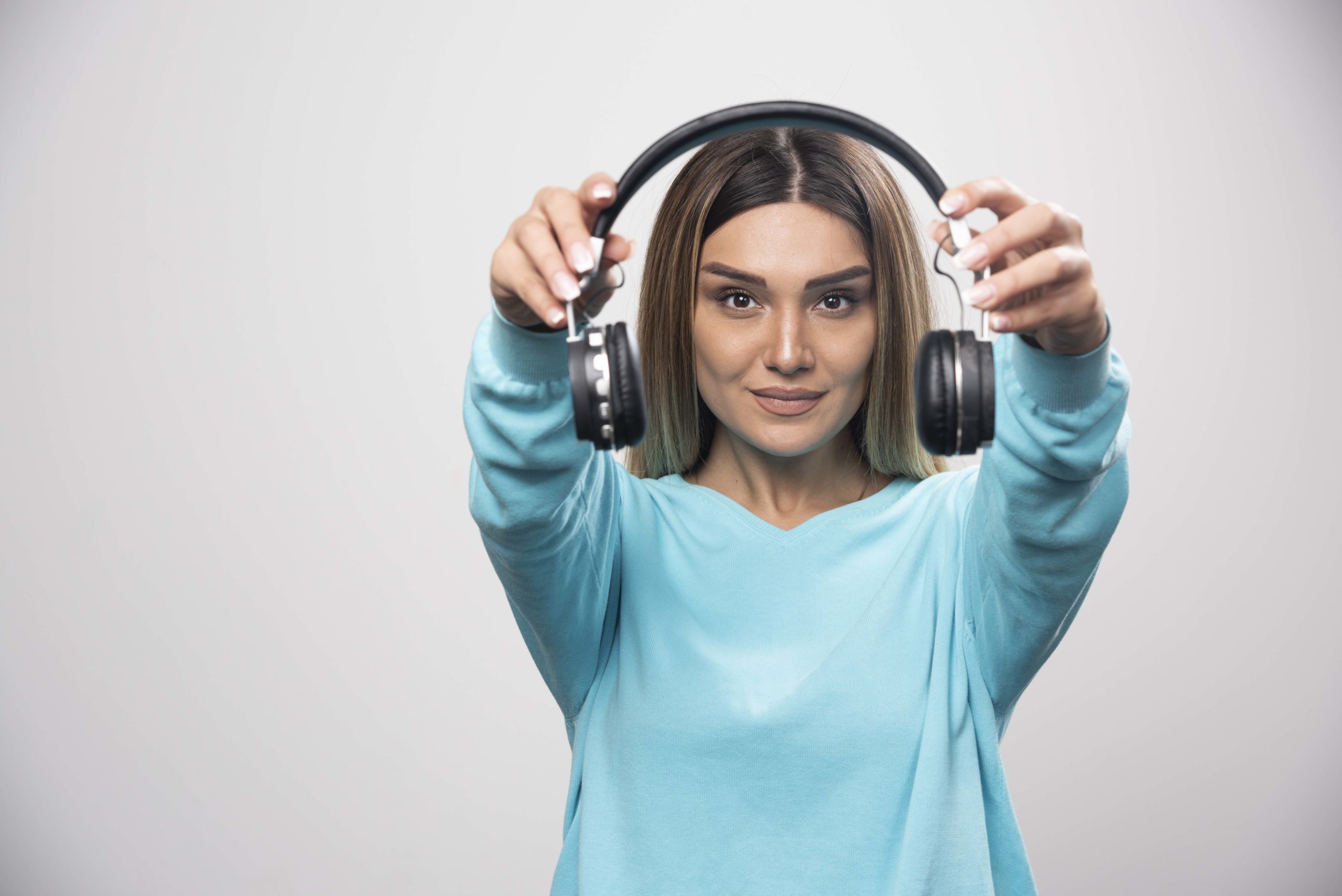
Another test we recommend is testing if you tin still hear your headphones at a altitude.
For this, remove your headphones while music is notwithstanding playing, and go along them at your usual volume level. Then, agree them out in front of you lot at an arm's length. Can you hear the music clearly? If so, try turning it downward and repeating again.
Pro tip: Endeavour non to play a song you are very familiar with — you will conceptualize the lyrics or beats, and that can make y'all feel like the book is high when it'southward actually depression.
3. Bank check the book control
At that place is no denying that some music is best listened to at louder levels. And it's so simple to crank upwardly the volumes when your favorite track begins to play. Information technology is important, though, to get into positive habits by ensuring that the volume stays below 60% of the book.
If y'all notice it creeping up to over two-thirds of the book control or over 60%, then it is also much for your ears.
"At threescore% volume, you tin can notwithstanding very conspicuously hear your music, and with skillful quality headphones, y'all'll be able to vibe along to every beat. Keeping the volume controlled is the easiest way to avert any problems with hearing loss that relates to headphones."
– Carreen P. Henson, Clinical Audiologist
Hearing loss may not occur overnight, but you tin can prevent it from happening by monitoring those volumes on a regular basis.
Some headphones may notwithstanding produce audio louder than the recommended 85dB fifty-fifty at 60% book, depending on the headphone impedance. If that'southward the case, it's better to rely on a audio meter instead of the device volume settings to measure the sound level accurately.
4. Ensure you don't struggle to hear people around you
If y'all struggle to pick out sounds in your environment when wearing your headphones, then your volume may exist too loud. You need to adjust the audio until yous can maintain a conversation with someone in the same room.
Effort turning down the volume until your friend doesn't sound muffled.
Just note that this test won't be effective if y'all accept noise-canceling headphones though.
v. Look out for signs of hearing loss
You may already be experiencing symptoms of hearing loss and don't realize information technology. This can be caused by listening to your headphones at a high volume. Loud noise can overwork and damage the hair cells in the ear, and yous will gradually lose your hearing.
"Usual early sign of hearing loss is difficulty in speech understanding. I take had many patients who come by in the clinic who land that they do hear spoken communication and sounds, simply they have difficulty agreement some words."
– Carreen P. Henson, Clinical Audiologist
Look out for symptoms such equally:
- Ringing, clicking, roaring, hissing, or buzzing in the ears
- Difficulty in hearing at rowdy venues
- Muffled sounds
- An increasing need to continue turning the volume upwardly
Bank check out some more symptoms of hearing loss so you tin can know what to wait out for. However, it'due south prudent to consult with a professional for a amend diagnosis and treatment of your hearing condition.
half-dozen. Measure the audio level with a Audio Meter
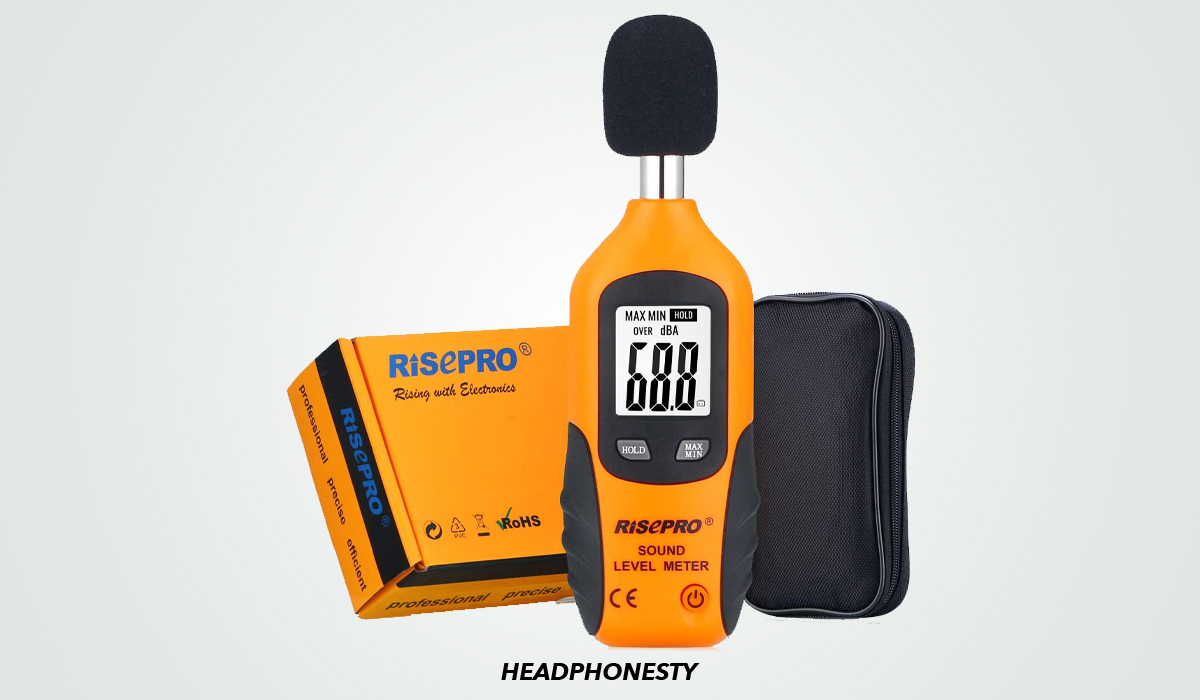
A sound or decibel meter is a device to measure audio levels in decibels (dB). With this device, you can brand use of the decibel chart above to measure out if your headphones are as well loud for you.
Take notation that although it says 94 dB is the average sound level for personal sound devices, it is still pretty damn loud. Keeping the audio level 10 – xx decibels beneath that will give your ears much relief in the long run.
To accurately measure the book using the sound meter, follow these steps:
- Connect your headphones to your audio source and play a song/audio at your typical volume.
- Hold your headphones out and turn on your decibel meter.
- Place the decibel meter mic direct to the inner function of ane of your headphones' earcups. The decibel meter should automatically bear witness the electric current dB on its LED screen.

Measuring headphone volume with decibel meter (From: Youtube/Techscrew) - Accommodate the device volume manually until it remains below 85dB.
Sound meters aren't always authentic but information technology gives a good gauge. The sound projected into your ears vs the sound picked upwardly past the meter can potentially be very different. Take the measurement with a pinch of common salt.
If buying a sound meter is out of your budget, you can opt to endeavor out different apps that can turn your gadgets into virtual book measuring device. Some of our most recommended apps are:
- For Android: Sound Meter
- For iOS: Decibel X
- For Windows: Decibel Meter
How to Habiliment Headphones Without Damaging Your Hearing
While headphones and earbuds present a potential danger of hearing loss, they aren't completely bad for your ears. It just depends on how you use them.
That's why to avoid all these worries, here'south a list of a few preventative tips that volition ensure you use your headphones safely. Let's dive in:
- Exist faithful to the threescore/threescore rule
- Employ volume limits
- Employ noise-canceling headphones
- Choose good-plumbing equipment headphones
- Apply Equalizers
Exist faithful to the threescore/lx rule
Information technology tin can be tempting to enhance the volume on your favorite playlist so yous can savor the music for an extended period. Simply, you shouldn't do that. Instead, Dr. Kelly Conroy, an audiologist, suggests sticking with the 60/60 rule.
Yous need to set the volume of your headphones to 60% and only heed to music for short periods of threescore minutes.
Luckily, this will exist easy to follow since your mobile device volition give yous a alert when you turn upwards the book beyond 60%.
After the 60-minute mark, remove your headphones and even charge them if you need to. This intermission gives the niggling hair cells in your ear culvert a chance to residuum and recover from all the vibrations.
Employ volume limits
There are two types of volume limits you can rely on to limit your exposure to loud sounds. They include congenital-in and settings-based volume limits.
Permit's break down each type:
Built-in book limits
The book-limiting headphones are mostly designed for kids and people with sensitive hearing. These headphones are designed with built-in volume limits, where the sound level is fix at a standard of 85dB.
While some volume-limiting headphones allow switching from 85 to 96 dB, congenital-in volume limits can't be bypassed and so you lot tin't adjust the settings to brand the volume whatsoever louder than that.
Settings-based volume limits
If y'all're non into ownership a new pair of headphones with built-in limits, you could set volume limits straight from your audio source, whether it'south a smartphone or tablet.
Here's how to admission the volume limit controls on both your iPhone and Android respectively:
How to enable book limits on iPhone
- Head to Settings and select Sound & Haptics.
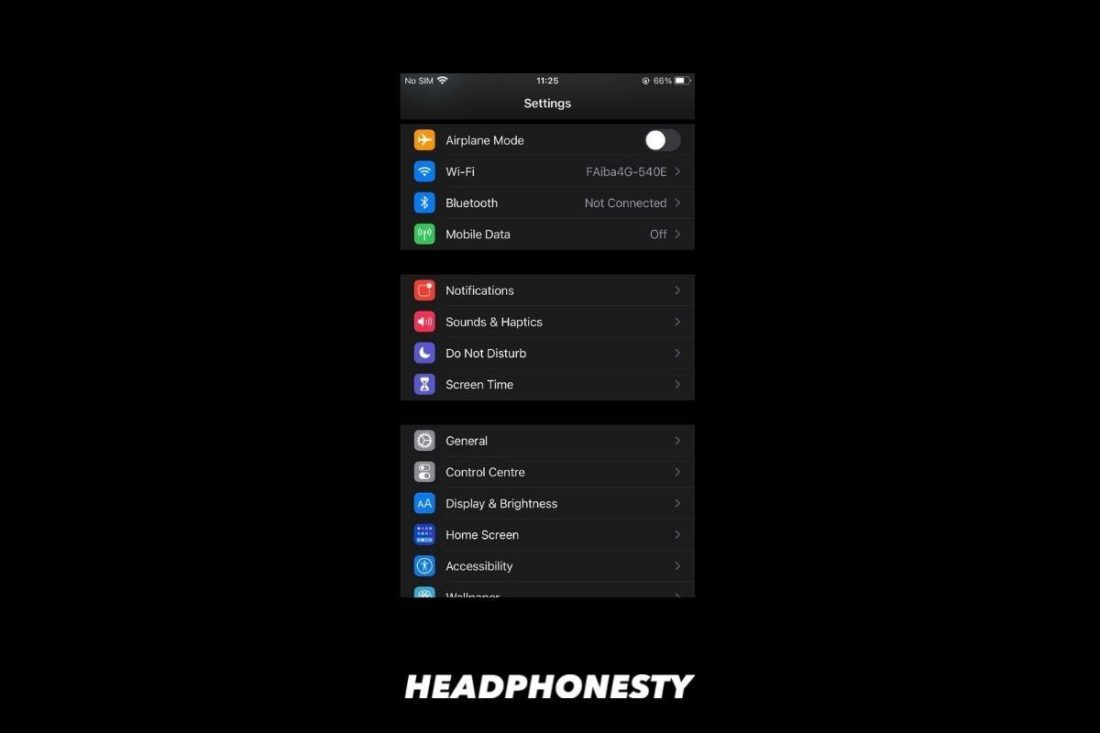
How to access Sound & Haptics on an iPhone. - Select Headphone Rubber.
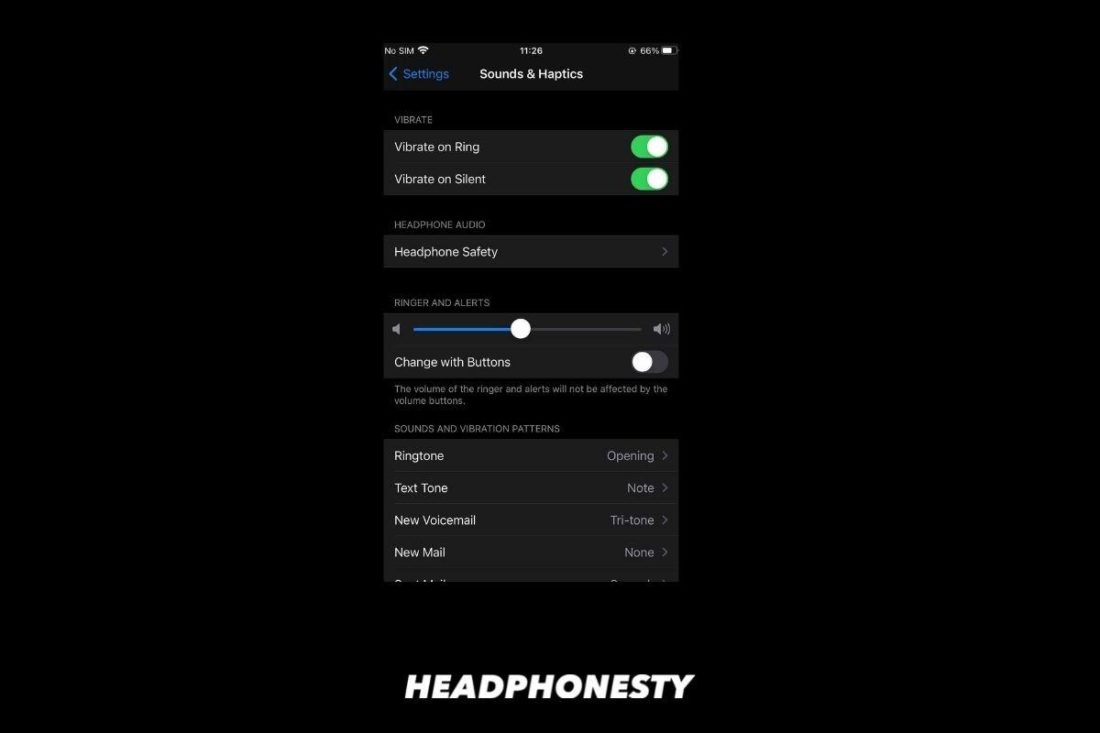
How to access Headphone Safety on an iPhone. - Toggle the Reduce Loud Sounds button and set the sound level to a maximum of 85 decibels.
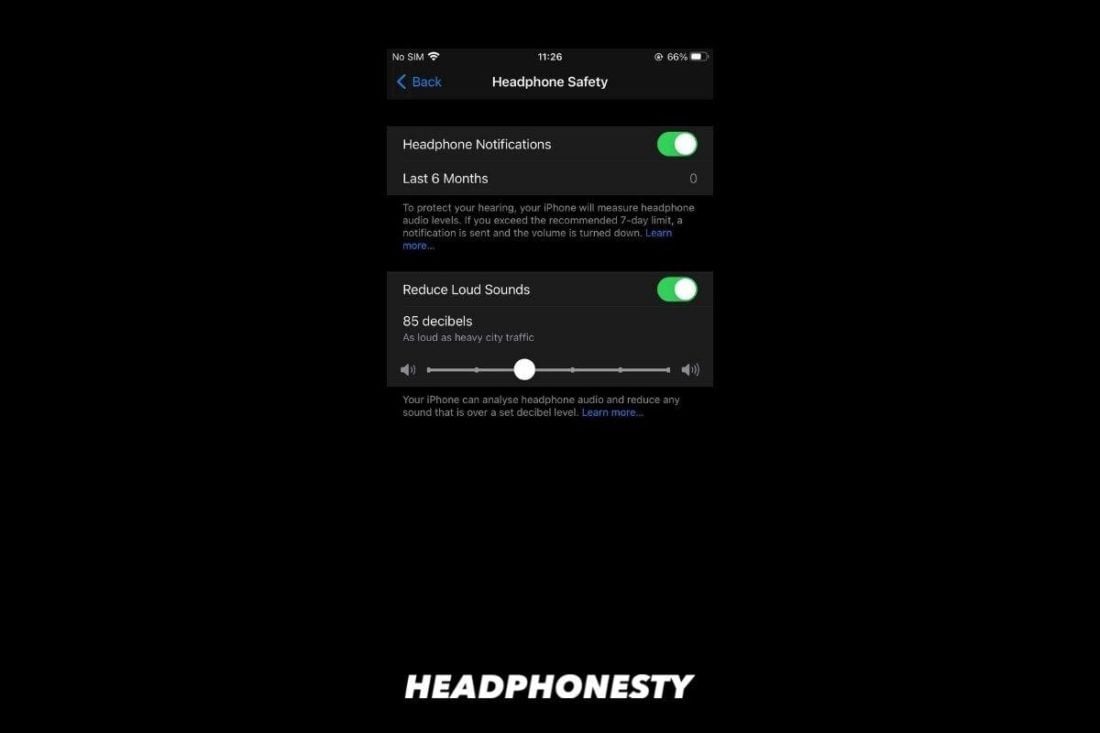
How to set the maximum volume limit on an iPhone.
How to enable volume limits on Android
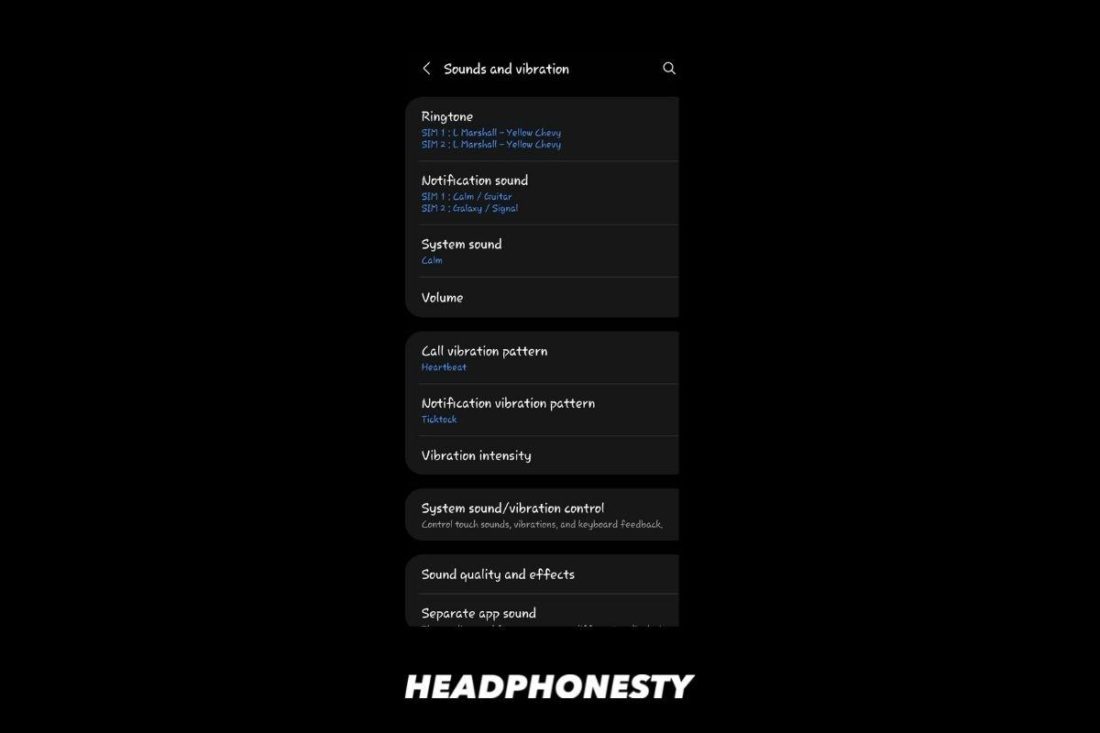
- Head to Settings and select Sounds and Vibration.
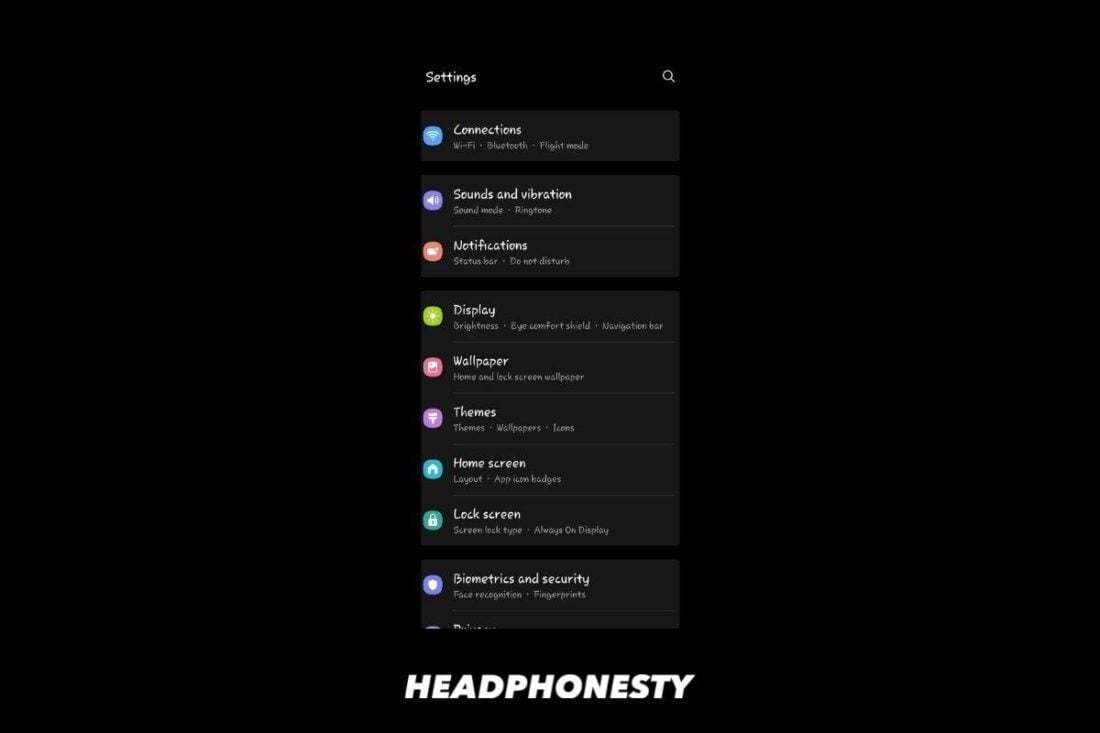
How to access Sounds and Vibration on an Android device. - And so select Volume.
Tap on the Book choice. - At the pinnacle right corner, tap the 3 buttons and select Media volume limit.
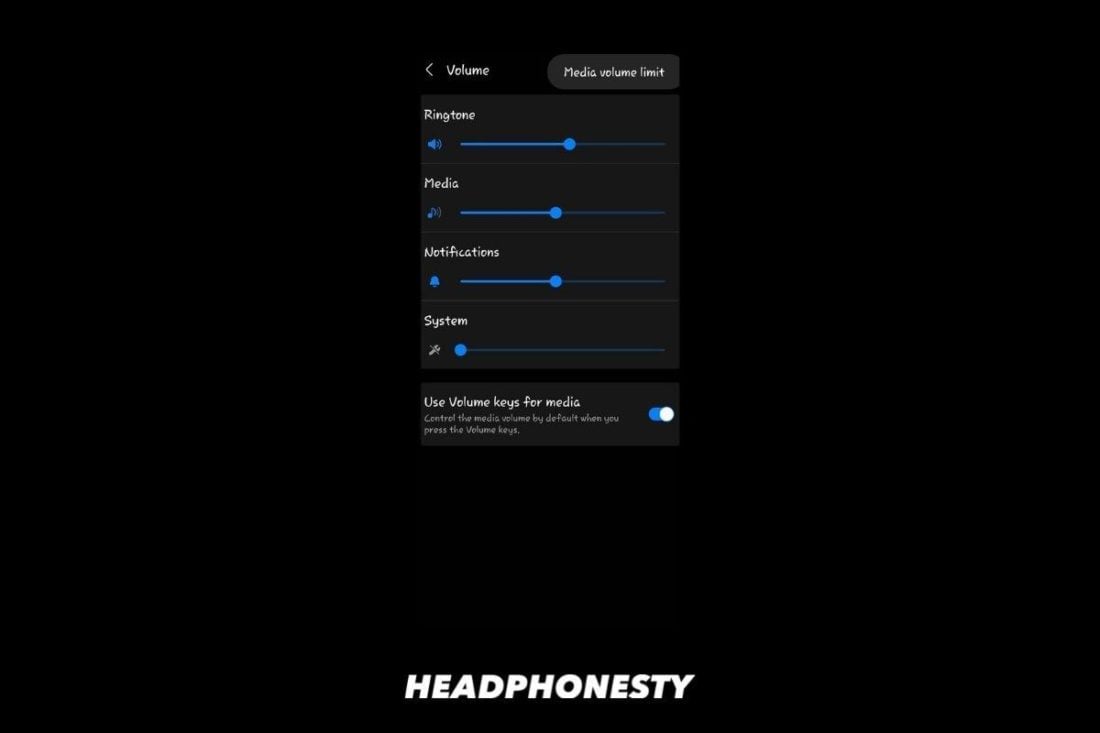
Three buttons at the meridian corner revealing the Media volume limit. - Toggle the off button to 'On' to customize the media book limit.
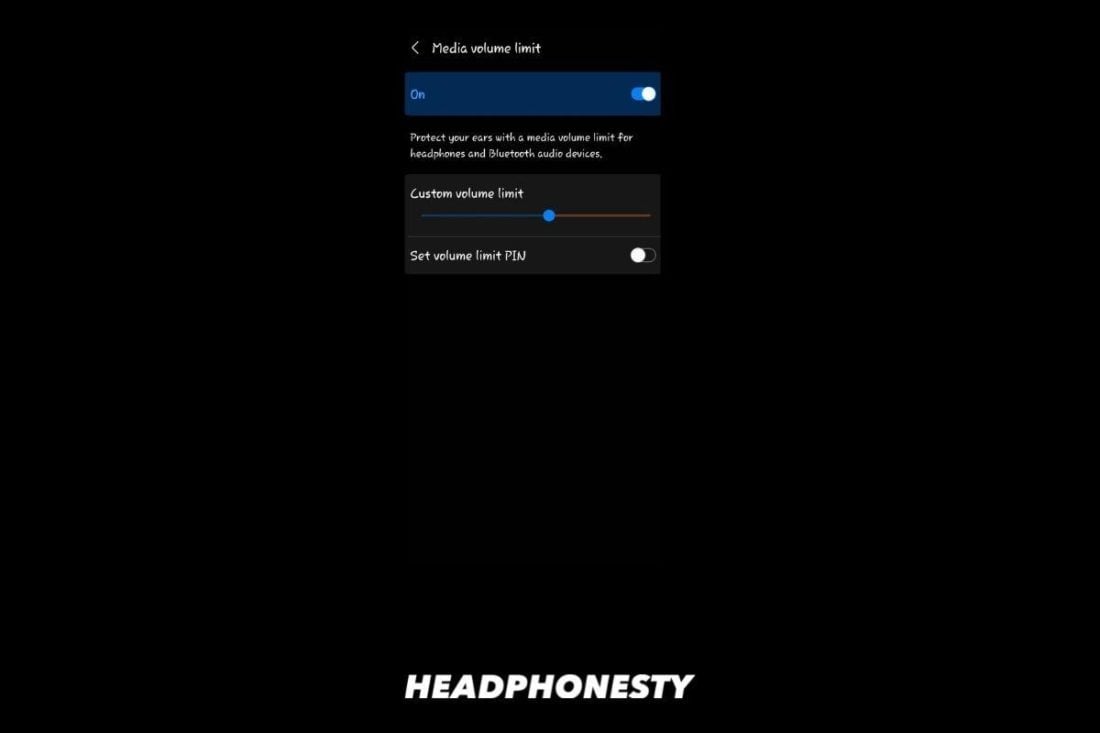
Customizing the volume limits on an Android device.
Yous can also endeavor using third-party apps for such as Volume Limiter or Volume Control to maintain safe listening levels on your Android device.
Employ racket-canceling headphones
At times, yous may plough the volume high on your headphones to drown out the noise in your environment. To avoid this, you could switch to racket-canceling headphones instead.
You lot can either have passive or active noise-canceling headphones. We recommend the latter since they actively cancel out unwanted groundwork noise by emitting sound waves that oppose the incoming sound waves from the environment.
In contrast, passive noise-canceling headphones, a.k.a. noise-isolating headphones, only create a concrete barrier in your ears to muffle background noise.
Noise-canceling headphones are prophylactic merely remember to go on observing the 60/60 listening rule since prolonged employ can all the same damage your ears.
Choose good-fitting headphones

The headphones' fit also affects how well the headphones' noise cancellation works.
Having a pair of loose-plumbing equipment headphones tin also let in unwanted background dissonance since they can't fully seal your ears. This tin can brand information technology seem like your music isn't loud enough and force you to plow it up past the recommended volume limits.
To counter this, yous should find a pair of well-fitting headphones that class a good seal over your ears.
With this respect, people who habiliment glasses may experience similar earbuds are a better choice than over-ear headphones. However, we recommend sticking to the latter. Since earbuds need to be inserted shut to the ear canal, they tin can cause more than damage than over-ear headphones.
Employ Equalizers
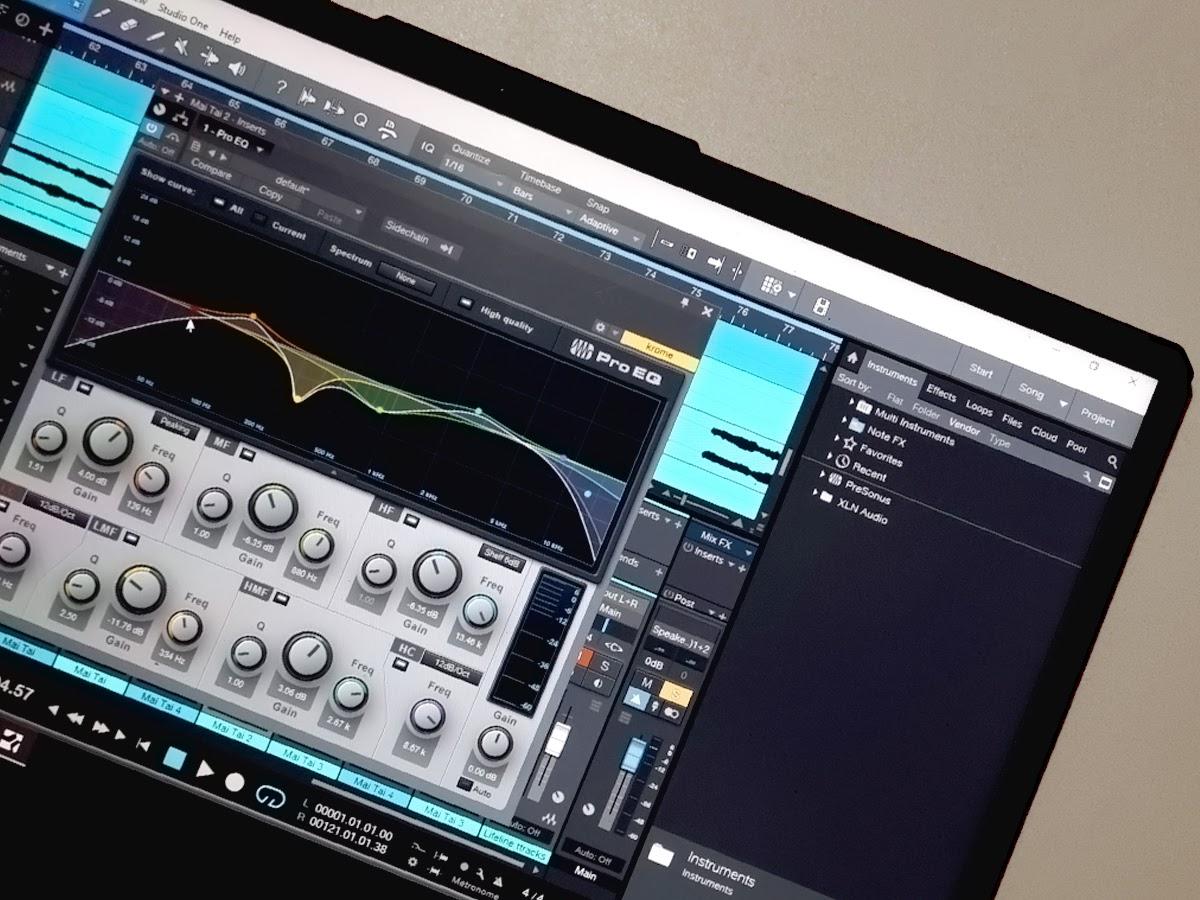
While lowering the headphone volume goes a long way in preventing ear impairment, it's not always going to work. This is because some sound frequencies can be more dangerous than others, even when played at low volumes.
Loftier-pitched racket (highs), in particular, tends to be more damaging than lows fifty-fifty when played at the same volume. The highs can make your ears more sensitive as they deliver a striking pressure level to your eardrum.
In contrast, lows are more tolerable in the ear, only prolonged vibrations can besides destroy the hair cells.
Every bit a way around this, you should consider customizing your headphone's equalizer settings. The equalizer lets you residual the highs, mids, and lows for safer listening. You can suit the frequencies until you become a decent audio that doesn't cause ear damage.
Determination
Hopefully, now you have everything you need to reduce the chances of early hearing loss, even for your kids. Yous won't take to put away your headphones, simply only learn how to set up book limits and as well limit your listening time.
With fourth dimension, you volition appreciate the 60-infinitesimal music breaks as yous requite your ears a chance to rest. It will as well requite you lot the time to curate a fresh playlist for your adjacent listening session.
Of course, it'southward also best to keep your hearing wellness in check.
"Information technology is recommended that you have your hearing checked at least every 6 months or once a year regardless of whether you take hearing loss or not. Early detection and direction are always better to help preserve our hearing."
– Carreen P. Henson, Clinical Audiologist
Are your headphones giving you ear-related problems? Practise you think the tips nosotros offered volition help reduce the risk of ear harm? Drib a comment beneath and share your thoughts with us.
Source: https://www.headphonesty.com/2017/03/5-ways-to-know-that-your-headphones-are-too-loud/

Post a Comment for "Does the Baby Hear What I Hear With Headphones"