8 Must-Have Sleep Technologies - Better sleeping through technology!
Some people sleep similar a bear in deep hibernation, while others may find a restful dark's sleep elusive. Every bit nosotros get older, information technology'southward not uncommon for slumber to be harder to come past. I, for one, used to sleep more than soundly than I do nowadays, and this frustrates me to no end. I know many people who wake upwards several times per night or stare at the ceiling for an hour waiting to fall comatose. But thanks to some new innovations in sleep engineering, I have an easier fourth dimension both falling and staying asleep. Being a science geek (and a encephalon geek), slumber—and the technologies surrounding it—is an surface area that absolutely fascinates me,
I started dabbling in this area a few years ago when I bought a Zeo. Remember those gadgets that yous would strap onto your brow at night? Yes, I owned one. I yet do, in fact, and the thing still works, despite the fact that the company has, sadly, gone out of business. I beloved tracking my slumber, despite looking more than a little geeky at bedtime having a sensor attached to my caput. The sensor not but tracks how much sleep you lot are getting, merely more chiefly, the blazon of sleep: deep sleep, light slumber, and REM sleep.
The Quantified Cocky (QS) movement is all most measuring and tracking everything yous can in relation to your torso, "only to what end?" you may inquire. There'due south an expression that goes: "That which gets measured gets managed." It's true in business, and information technology's truthful in life, and nosotros should apply this to our sleeping habits. Once I start tracking my slumber metric I can work to ameliorate it. By making changes to my nighttime routine, what I slumber on, what I wear, the amount of light I am exposed to in the morning, and how I wake in the morning, I can tweak sure variables to help me go a skillful night's rest.
How many of u.s. actually measure anything scientifically about our sleep? I would wager a very slim minority. Many of united states of america count calories, megabytes, and minutes of time at work with high levels of scrutiny—why ignore 1 of the most basic and important functions of our lives?
A study done by The University of Maryland Medical Center reports that fifty% of people have sleep difficulties, and that 65% of us don't get our prescribed viii hours of sleep per 24-hour interval. This should come equally no surprise when you lot consider how demanding our lives have go in this engineering science-infused culture. Without adequate rest, we become more than susceptible to affliction, poor cerebral function, traffic accidents due to drowsy drivers, and even increased risk of an early expiry.
Tech time is displacing pillow time, to the point where somewhere between 25% and 35% of those who have a smartphone, laptop, or tablet cheque Facebook in bed. Using these devices earlier bed has been shown to reduce melatonin levels and disrupt your power to fall asleep. While at that place are technologies that are detrimental to our sleep, there are also a number of technologies (such as the aforementioned Zeo) that are helpful in getting a satisfying night'due south rest. Let'south have a look at some of them, starting with the tracking devices:
1. Sleep Monitors
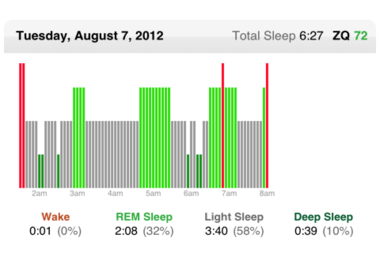
Despite my dear for the Zeo, I'd suggest y'all go with some other monitor, one that's not discontinued (patently). A monitor that directly measures brainwaves will provide the greatest accuracy, such as a bedside EEG unit of measurement. Be warned, the price is steep—ranging from $600 and up.
For something more affordable (between $100 to $150), at that place's Fitbit Flex and Jawbone UP24, which seem to be bearing the latest torch in sleep analytics. Instead of being worn on the caput like an EEG monitor, they are worn effectually the wrist, and utilise movement during sleep equally an indicator of sleep patterns. This isn't equally accurate of an approach, only it turns out to correlate pretty well.
Your least expensive (and least accurate) pick is to use your iPhone or Android phone and a sleep tracking app like Slumber As Android, Sleep Wheel, Sleep Bot, or Sleep Time to measure your nighttime slumber movements. Y'all simply exit the phone on your bed to "feel" for movement during the dark.
ii. Smart Alarms
If you're like most people, you wake upward with an alarm. They can be jarring to say the least, especially if you happen to be in deep slumber. Most alarms take no regard for your sleep wheel. And they disturb your partner, to boot. Enter the aforementioned Fitbit Flex and Jawbone UP, both of which will wake you by vibrating on your wrist then only you wake up and not your partner. Nice! Even meliorate if the device is aware of your sleep bike, so that you are awakened during calorie-free sleep within a fourth dimension window that you specify. That's where the Jawbone Upwardly surpasses the Fitbit Flex. The Upwards has such a feature, called a "Smart Alarm." The Zeo, likewise, has this (called SmartWake). As do the various aforementioned smartphone apps. Why Fitbit has all the same to include this capability, I don't know, but let's promise information technology'south forthcoming.
3. SleepGuard
My fiancée has experienced sleep difficulties as of late, stemming from her new Invisalign "braces" and the resulting clenching she'south doing at night while wearing them. Investigating this problem led me to another fascinating technology called SleepGuard, a biofeedback monitor for those who clamp or grind teeth. This makes more sense to me than a plastic nighttime baby-sit, which simply works to stop the article of clothing on the teeth without addressing the muscle tension from clenching/grinding and its ill furnishings.
The machine, which is worn every bit a headband monitor, sends out tiny beeping sounds during the night whenever the wearer clenches his or her teeth. The beeping gradually gets louder if they do non terminate, and eventually works equally a blazon of subconscious encephalon training to cease the habit.
The biofeedback headband also lets you lot quantify how much you clench in total during the night. According to the inventor of SleepGuard, Lee Weinstein, if you clench more than than about 100 seconds per night, the clenching is probable blocking your transition to REM slumber. By cutting downwards on the clenching you can increase REM. More than importantly, if you clench more than about 100 seconds per night and get migraines, Weinstein asserts you have almost a 90% chance of being able to foreclose your migraines by reducing the clenching.
4. Wicking Sheets & Sleepwear
Some would contend that any bed setting is merely equally good as the "linens" or sheets accompanying. SHEEX is a personal get-to line for me, mostly because their fabric is much more than breathable and libation than traditional cotton sheets. The fabric wicks away excess wet from our sweating bodies while we slumber—a big demand for those of u.s.a. who live in hot and oft humid climates. SHEEX also has a sleepwear line (T-shirts, shorts, and the similar) made with the aforementioned material.
5. Sleep Mask
Lite tin can be pervasive and inescapable in our bedrooms, especially in cities. Tempur-Pedic's contoured SleepMask is a groovy solution: complete darkness without existence restrictive or uncomfortable, and more chic than the frilly and lace-embroidered monstrosities you used to see gracing Aunt Edna'due south bedside table. It's helpful when traveling, also.
half dozen. Blackout Blinds or Shades
Instead of a sleep mask, you may prefer to use blackout blinds or shades to prevent low-cal from entering the room in the first place. Blackout blinds are less disruptive to your slumber than a mask that attaches to your head and tin can pinch or sideslip off during the nighttime. Blinds have moveable slats, whereas shades are one slice of material that raises and lowers, making shades, generally speaking, better insulators of lite.
Blackout blinds/shades typically employ a special material, such every bit mylar or aluminum lining, to serve as a light bulwark. They besides forestall calorie-free leakage by having no gap effectually the edge of the shade, thank you to a special channel that captures the edge of the shade.
A more than economic option to "blackout" is "room-darkening," though it also ways a bit more light leakage.
If blinds or shades aren't going to work because of the size or shape of your windows, consider blackout material-lined defunction.
7. Contoured Pillows
Pillows are frequently undervalued equally part of the sleep set, but consider this: they support your caput, your neck, and by extension, your spine. Sunken, depleted pillows can lead to headaches, kinks or pain in the neck and shoulders. The problems are exacerbated by sitting at a computer for hours on end, inactivity, and the sedentary lifestyle mutual to many 21st century individuals. Contour pillows are shaped to provide optimal support. They come in different shapes and sizes, so information technology's important to cull the right i for the blazon of sleeper you are. For instance, if yous sleep by and large on your stomach, don't purchase one that's designed for those who sleep primarily on their backs.
8. Cooling Gel
I'm a fan of retentiveness cream, but gel takes it to some other level. Not simply does the gel conform nicely to your body, its cooling properties keep you from sweating while you sleep. Sweating at nighttime is definitely to be avoided if you desire a good nighttime'southward residual. The cooling gel is added to a memory foam base of operations in both mattresses and pillows. A give-and-take of caution: avoid using a mattress pad on a gel mattress, as it will interfere with the gel'due south cooling properties.
I recently made the error of purchasing an inexpensive gel pillow. When I got abode and opened my new pillow, much to my horror, I was greeted past a baneful odour that didn't diminish even after two days of airing it out. I had to return that nasty thing! Lesson learned: beware of cheap knockoffs. Quality is worth the investment, especially when it involves your slumber, where you spend a huge chunk of your life. I ended upwardly buying a fantastic gel mattress and gel pillows from Technogel, a Dr. Scholls make. Who would accept guessed that Dr Scholls made beds!
Here are a couple cooling alternatives to gel worth checking out likewise: TEMPUR-Breeze and DualTemp.
Bring on the Tech!
Slumber is likewise of import for your wellness to not have seriously and accost the causes of your tossing-and-turning. Your brain and other organs need slumber time for repair and rejuvenation. A practiced nighttime's residue is an investment in a healthier listen and body, and hopefully longer life. Amend living, or should I say, better sleeping, is possible through technology!
Source: https://www.lifehack.org/articles/lifestyle/8-must-have-sleep-technologies.html

Post a Comment for "8 Must-Have Sleep Technologies - Better sleeping through technology!"