Explain How You Can Prove the Difference of Two Cubes Identity. A3 – B3 = (a – B)(A2 + Ab + B2)
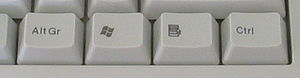
The AltGr cardinal is the first key to the correct of the space bar. (Some keyboards take a 2d Alt key here).

A keyboard with additional engravings showing the characters typed when AltGr is held down. (The AltGr key, located immediately to the right of the Space bar, does non appear in this photo.)
AltGr (also Alt Graph) is a modifier key found on many computer keyboards (rather than a second Alt key found on The states keyboards). It is primarily used to type characters that are not widely used in the territory where sold, such as foreign currency symbols, typographic marks and absolute letters. On a typical Windows-uniform PC keyboard, the AltGr key, when present, takes the identify of the right-hand Alt primal: if not engraved equally such, that key may still be remapped to acquit equally though it is,[one] (or emulated using a chord such as Ctrl+Alt). In macOS, the Option key has functions similar to the AltGr fundamental.
AltGr is used similarly to the Shift key: information technology is held down while another primal is struck in order to obtain a character other than the one that the latter commonly produces. AltGr and Shift can likewise sometimes be combined to obtain all the same another graphic symbol. For instance, on the United states of america-International keyboard layout, the C central can be used to insert four different characters:
- C → c (lower case — kickoff level)
- ⇧ Shift+C → C (upper case — second level)
- AltGr+C → © (copyright sign — third level)
- AltGr+⇧ Shift+C → ¢ (cent sign — fourth level)
Meaning [edit]
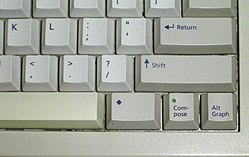
IBM states that AltGr is an abbreviation for alternate graphic.[ii] [three]
The AltGr primal is used as an additional 'shift' fundamental, to provide a third and a 4th (when Shift is also pressed) character for most keys. Most are accented variants of the letters on the keys, just likewise additional typographical symbols and punctuation marks. Some languages such as Bengali use this key when the number of letters of their alphabet is too large for a standard keyboard. On early on home computers the alternate graphemes were primarily box-cartoon characters.[4]
Office by default national keyboard [edit]
In most of the keyboard diagrams the symbol you get when holding downwardly AltGr is in blue in the lower-correct of the corner. If dissimilar, the symbol for Shift+AltGr is shown in the upper-right.
People's republic of bangladesh [edit]
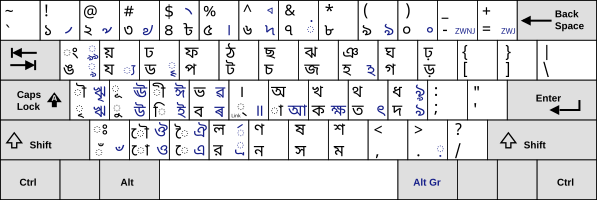
Jatiya Layout (Alt Gr activated characters in bluish)
Belgium [edit]
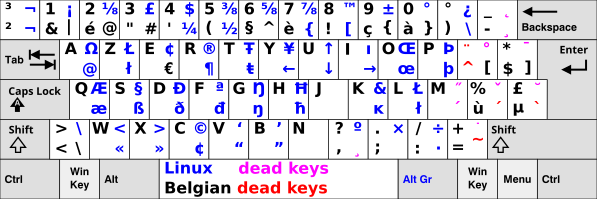
Belgian keyboard under Linux (Ubuntu nine.10)
The Windows version of the Belgian keyboard may but support a subset of these characters. Several of the AltGr combinations are themselves dead keys, which are followed by some other letter to produce an absolute version of that letter.
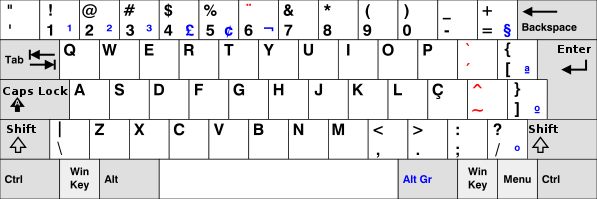
Brazil [edit]

ABNT complying keyboard layout (Alt Gr activated characters in blueish)
ABNT2 complying keyboard layout (Alt Gr activated characters in blue)
Some notes [edit]
- The AltGr+C combination results in the (obsolete) symbol ₢ for the former Brazilian currency, the Brazilian cruzeiro.
- The AltGr+Q, AltGr+W, AltGr+East combinations are useful as a replacement for the "/?" central, which is physically absent-minded on non-Brazilian keyboards.
- Some software (eastward.g. Microsoft Word) will map AltGr+R to ® and AltGr+T to ™, but this is not standard behavior and was likely an blow attributable to the fact that the combinations Ctrl+Alt+R and Ctrl+Alt+T were intended. Windows interprets Ctrl+Alt every bit AltGr.[five]
France [edit]
On AZERTY keyboards, AltGr enables the user to type the post-obit characters:
|
|
Germany [edit]
On High german keyboards, AltGr enables the user to blazon the following characters, which are indicated on the keyboard:
|
|
|
Windows viii introduced the ability of pressing AltGr+⇧ Shift+ß to produce ẞ (capital ß). Even though this is commonly not indicated on the concrete keyboard—potentially due to a lack of space, since the ß-key already has 3 dissimilar levels (ß → "ß", ⇧ Shift+ß → "?", and, as shown above, AltGr+ß → "\")—, it tin can be seen in the Windows On-Screen Keyboard by selecting the necessary keys with the High german keyboard layout selected.
(Some newer types of German keyboards offer the fixed assignment Alt+++H → ẞ.)
Greece [edit]
On Greek keyboards, AltGr enables the user to type the following characters:
- Digits row
- AltGr+2 → ²
- AltGr+3 → ³
- AltGr+4 → £
- AltGr+5 → §
- AltGr+half dozen → ¶
- AltGr+8 → ¤
- AltGr+ix → ¦
- AltGr+0 → °
- AltGr+- → ±
- AltGr+= → ½
- Top letters row
- AltGr+Ε → €
- AltGr+Ρ → ®
- AltGr+Υ → ¥
- AltGr+[ → «
- AltGr+] → »
- AltGr+\ → ¬
- Middle letters row
- AltGr+; → ΅(a dead cardinal:AltGr+; then i → ΐ)
- Bottom letters row
- AltGr+Ψ → ©
Some of these cardinal combinations also outcome in different characters if the polytonic layout is used.
State of israel [edit]
Hebrew [edit]
On Hebrew keyboards, AltGr enables the user to type the following characters:
- AltGr+4 → ₪
- AltGr+iii → €
There are several combinations using AltGr that actuate Hebrew vowels.
Yiddish [edit]
Using a Hebrew keyboard, ane may write in Yiddish equally the two languages share many letters. However, Yiddish has some boosted digraphs and a symbol not otherwise found in Hebrew which are entered via AltGr.
- AltGr+- → פֿ
- AltGr+י → ײ
- AltGr+ח → ױ
- AltGr+ו → װ
Italy [edit]
On Italian keyboards, AltGr enables the user to type the following characters:
|
|
In that location is an alternate layout, which differ just in disposition of characters accessible through AltGr and includes the tilde and the curly brackets.
Republic of latvia [edit]
The following letters can be input in the Latvian keyboard layout using AltGr:
Lowercase letters [edit]
| Uppercase letters [edit]
|
North Macedonia [edit]
On Macedonian keyboards, AltGr enables the user to type the post-obit characters:
|
|
|
The Netherlands [edit]
- Digits row
- AltGr+1 → ¹ and ¡
- AltGr+2 → ²
- AltGr+3 → ³
- AltGr+iv → £ and ¤
- AltGr+5 → €
- AltGr+6 → ¼
- AltGr+7 → ½
- AltGr+8 → ¾
- AltGr+9 → '
- AltGr+0 → '
- AltGr+- → ¥
- AltGr+= → × and ÷
- Top letters row
- AltGr+Q → ä and Ä
- AltGr+Westward → å and Å
- AltGr+E → é and É
- AltGr+R → ®
- AltGr+T → þ and Þ (Icelandic and Old English thorn)
- AltGr+Y → ü and Ü
- AltGr+U → ú and Ú
- AltGr+I → í and Í
- AltGr+O → ó and Ó
- AltGr+P → ö and Ö
- AltGr+[ → «
- AltGr+] → »
- AltGr+\ → ¬ and ¦
- Middle letters row (Habitation row)
- AltGr+A → á and Á
- AltGr+Southward → ß (German eszett aka sharp south) and §
- AltGr+D → ð and Ð (Icelandic edh)
- AltGr+L → ø and Ø
- AltGr+; → ¶ and °
- AltGr+' → ´ and ¨
- Bottom letters row
- AltGr+Z → æ and Æ
- AltGr+C → © and ¢
- AltGr+N → ñ and Ñ
- AltGr+Chiliad → µ
- AltGr+, → ç and Ç
- AltGr+/ → ¿
Nordic countries and Estonia [edit]
The keyboard layouts in the Nordic countries (Kingdom of denmark (DK), Faroe Islands (FO), Finland (FI), Norway (NO) and Sweden (SE) as well every bit in Estonia (EE)) are largely like to each other. Generally the AltGr key can be used to create the following characters:
|
|
Other AltGr combinations are peculiar to just some of the countries:
|
|
Finnish multilingual [edit]
The Finnish multilingual keyboard standard adds many new characters to the traditional layout via the AltGr key, every bit shown in the image below (the blue characters can be written with the AltGr cardinal; several expressionless primal diacritics, shown in cherry-red, are also available as an AltGr combination).[half-dozen] [seven]

Poland [edit]
Typewriters in Poland used a QWERTZ layout specifically designed for the Shine language with accented characters obtainable direct. When personal computers became available worldwide in the 1980s, commercial importing into Poland was non supported by its communist government, and then almost machines in Poland were brought in by private individuals. Most had US keyboards, and various methods were devised to make special Polish characters available. An established method was to use AltGr in combination with the relevant Latin base of operations letter to obtain a precomposed grapheme with a diacritic; notation the exceptional combination using x instead of the base of operations letter z, every bit the Latin base alphabetic character has been reserved for another combination:
- AltGr+A → ą
- AltGr+C → ć
- AltGr+Eastward → ę
- AltGr+50 → ł
- AltGr+N → ń
- AltGr+O → ó
- AltGr+Southward → ś
- AltGr+U → €
- AltGr+X → ź
- AltGr+Z → ż
At the fourth dimension of the political transformation and opening of commercial import channels this exercise was and then widespread that it was adopted as the de facto standard. Nowadays near PCs in Poland have standard Us keyboards and utilise the AltGr method to enter Polish diacritics. This layout is referred to as Polish programmers' layout ( klawiatura polska programisty ) or simply Polish layout.
Another layout is nonetheless used on typewriters, generally past professional person typists. Computer keyboards with this layout are bachelor, though hard to find, and supported by a number of operating systems; they are known as Polish typists' layout ( klawiatura polska maszynistki ). Older Polish versions of Microsoft Windows used this layout, describing it as Polish layout. On current versions it is referred to as Shine (214).
Romania [edit]
The keymap with the AltGr central:
â ß € r ț y u î o § „ " ă ș đ f g h j k ł ; z ten © v b n m « »
Russian federation [edit]
Since release 1903, versions of Windows 10 have the bounden:
- AltGr+8 → ₽ (Ruble sign)
South Slavic Latin [edit]
On S Slavic Latin keyboards (used in Croatia, Slovenia, Bosnia and Herzegovina, Montenegro and Serbia), the following messages and special characters are created using AltGr:
|
|
|

Turkey [edit]
In Turkish keyboard variants the AltGr tin can be used to brandish the following characters:
- AltGr+a → æ
- AltGr+southward → ß
- AltGr+e → €
- AltGr+t → ₺
- AltGr+q → @
- AltGr+ı → i
- AltGr+ü a → ã
- AltGr+ğ a → ä
- AltGr+ş a → á
- AltGr+, a → à
United kingdom and Ireland [edit]

|
|
In Great britain and Ireland keyboard layouts, only ii alternative use symbols are printed on most keyboards, which crave the AltGr central to function. These are:
- € the euro sign. Located on the "4/$" fundamental.
- ¦ the broken bar symbol. Located on the "`/¬" key, to the immediate left of "one".
Using the AltGr cardinal on Linux produces many foreign characters and international symbols, e.thou. ¹²³€½{[]}@łe¶ŧ←↓→øþæßðđŋħjĸł«»¢""nµΩŁE®Ŧ¥↑ıØÞƧЪŊĦJ&Ł<>©''Nº×÷· (If reconfigured equally a compose key, an even larger repertoire is available).
With the United kingdom extended keyboard setting (beneath), Chrome Os offers a large repertoire of symbols and precomposed characters.
Scotland and Wales [edit]
For the diacritics used by Welsh (ŵ and ŷ) and Scots Gaelic (à, è, ì, ò and ù), the Britain extended keyboard setting is needed. This makes available AltGr+6 (for circumflex accent) and AltGr+` (for grave emphasis) as expressionless keys.
UK extended keyboard layout [edit]
The UK-Extended keyboard mapping (available with Microsoft Windows, Linux and ChromeOS) allows many characters with diacritical marks (including those used in other European countries) to be generated by using the AltGr key or expressionless keys in combination with others.
| ¬ ◌ ◌ ¦ | ! ¡ one ¹ | " ½ 2 ◌ | £ ⅓ three ³ | $ ¼ 4 € | % ⅜ v ½ | ^ ⅝ 6 ◌ | & ⅞ 7 { | * ™ viii [ | ( ± 9 ] | ) ° 0 } | _ ¿ - \ | + ◌ = ◌ |
| tab | Q Ω q @ | W Ẃ w ẃ | E É east é | R ® r ¶ | T Ŧ t ŧ | Y Ý y ý | U Ú u ú | I Í i í | O Ó o ó | P Þ p þ | { ◌ [ ◌ | } ◌ ] ◌ |
| 🔍 | A Á a á | Southward § due south ß | D Ð d ð | F ª f đ | G Ŋ chiliad ŋ | H Ħ h ħ | J ◌ j ◌ | Yard & k ĸ | L Ł l ł | : ◌ ; ◌ | @ ◌ ' ◌ | ~ ◌ # ◌ |
| shift | | ¦ \ | | Z < z « | X > x » | C Ç c ç | V ' five " | B ' b " | N N n n | M º m µ | < × , ─ | > ÷ . · | ? ◌ / ◌ |
Notes: Dotted circle (◌) is used here to bespeak a expressionless key. The ` (grave emphasis) key is the only one that acts equally a free-standing dead key and thus does not answer as shown on the key-cap. All others are invoked by AltGr.
AltGr+⇧ Shift+0 (°) is a degree sign; AltGr+⇧ Shift+M (º) is a masculine ordinal indicator. For a complete list of the characters available using dead keys, see QWERTY#Chrome Bone.
U.s. [edit]
Nigh keyboards sold in the US do non take an (engraved) AltGr primal. However if in that location is an correct-hand Alt key it will act as AltGr if a layout using information technology is installed (conversely a foreign keyboard AltGr will act like the right-paw Alt if the standard Usa keyboard layout is installed).
On some compact keyboards similar those of netbooks, the right-hand Alt may be missing altogether. Microsoft Windows (and some other Os's) emulate the cardinal with Ctrl+Alt: typing Ctrl+Alt+A is the same every bit AltGr+A.[ citation needed ] Microsoft recommends that this combination not exist used every bit part of a keyboard shortcut as users attempting to type AltGr characters will instead trigger the shortcut.[5]
The states-International [edit]
Microsoft provides a The states-International keyboard layout that uses AltGr (or right-hand Alt or Ctrl+Alt) key to produce more than characters:
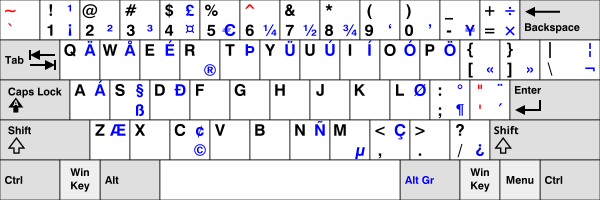
Red characters are dead keys; for case ä can be entered with " a.
Other operating systems such as Linux and Chrome Os follow this layout only increment the repertoire of glyphs provided.
X Window Organisation [edit]
In the X Window Arrangement (Linux, BSD, Unix), AltGr tin can often be used to produce boosted characters with most every key on the keyboard. Furthermore, with some keys, AltGr will produce a expressionless key; for example on a United kingdom keyboard, semicolon tin exist used to add together an acute accent to a base letter, and left square bracket can be used to add a trema:
- AltGr+; followed past E → é
- AltGr+[ followed past ⇧ Shift+O → Ö
This use of dead keys enables one to blazon a broad variety of precomposed characters that combine various diacritics with either uppercase or lowercase letters, achieving a like effect to the Etch cardinal.
Keyboard maps [edit]
Below are some diagrams and examples of country-specific fundamental maps. For the diagrams, the gray symbols are the standard characters, yellow is with ⇧ Shift, cherry is with AltGr, and blueish is with ⇧ Shift+AltGr.
Danish keyboard [edit]
The Danish keymap features the following fundamental combinations:
- AltGr+⇧ Shift+Q → Ω
- AltGr+O → ø
- AltGr+K → µ
Italian keyboard [edit]
The Italian keymap includes, amongst other combinations, the following:
|
|
Norwegian keyboard [edit]

The complete Norwegian X Window cardinal map with its AltGr combinations
Swedish keyboard [edit]

The complete Swedish X Window primal map with its AltGr combinations
See also [edit]
- Modifier primal
- Pick key
- Shift fundamental
- Dead key
- Escape character
- Etch key
- Windows Alt keycodes
- Precomposed grapheme
References [edit]
- ^ Microsoft Back up. "How to use the United states of america-International keyboard layout in Windows 7, in Windows Vista, and in Windows XP". Microsoft. Retrieved 30 May 2020.
- ^ "Keyboard Technical Reference". ibm.com. Archived from the original on fourteen Jan 2006. Retrieved 4 June 2005.
- ^ "IBM Globalization – Alternate graphic". ibm.com.
- ^ Kaplan, Michael South.: "To beginning press the ALTGR key." Hmm... where's the ALTGR key?. 28 December 2004.
- ^ a b Raymond Chen (29 March 2004). "Why Ctrl+Alt shouldn't be used every bit a shortcut modifier". Microsoft.
- ^ SFS 5966 Keyboard layout. Finnish-Swedish multilingual keyboard setting. Finnish Standards Clan SFS. 3 November 2008.
- ^ Kotoistus: Uusi näppäinasettelu = Status of the new Keyboard Layout Archived 27 July 2022 at the Wayback Machine. A bi-lingual (Finnish + English) presentation folio collecting drafts of the Finnish Multilingual Keyboard. CSC – Information technology Heart for Science Ltd. Page updated 28 December 2006.
| Esc | F1 | F2 | F3 | F4 | F5 | F6 | F7 | F8 | F9 | F10 | F11 | F12 | PrtScn/ SysRq | Scroll Lock | Suspension/ Intermission | |||||||||
| | Insert | Home | PgUp | Num Lock | ∕ | ∗ | − | |||||||||||||||||
| Delete | Cease | PgDn | 7 | eight | 9 | + | ||||||||||||||||||
| iv | 5 | vi | ||||||||||||||||||||||
| ↑ | 1 | 2 | 3 | Enter | ||||||||||||||||||||
| ← | ↓ | → | 0 Ins | . Del | ||||||||||||||||||||
Source: https://en.wikipedia.org/wiki/AltGr_key
(A2 + Ab + B2))
Post a Comment for "Explain How You Can Prove the Difference of Two Cubes Identity. A3 – B3 = (a – B)(A2 + Ab + B2)"